Christos Karapoulitidis

Affiliation
Stevens Institute of Technology
Supervisors
- Igor Pikovski (Stevens Institute of Technology)
- Shimon Kolkowitz (University of California
- Berkeley)
Short bio
I’m a PhD student at Stevens Institute of Technology in Igor Pikovski's research group, working at the interface of quantum mechanics and general relativity. Prior to my doctoral studies, I earned a bachelor’s degree in physics at Aristotle University of Thessaloniki and completed a master’s degree in theoretical physics at Heidelberg University. My current research interests lie in how tools from quantum information can be used to probe the interplay between gravity and quantum systems. During the Enrico Fermi Fellowship period, I aim to collaborate with Shimon Kolkowitz's experimental group to explore how next-generation optical lattice clocks can test foundational principles of relativity in regimes where quantum coherence plays a central role.
Testing the Gravity-Quantum Interface with Optical Lattice Atomic Clocks
One of the striking predictions of general relativity is that gravity affects the passage of time. Clocks at higher altitude, where gravity is weaker, tick faster than those lower down, a phenomenon called gravitational time dilation or gravitational redshift. Today's best optical atomic clocks have reached a level of precision that enables these differences to be resolved over height variations of just a few millimeters. This remarkable sensitivity has transformed atomic clocks from instruments of timekeeping into powerful probes of fundamental physics.
But quantum mechanics adds a new layer to this changing passage of time: a single clock can be in a quantum superposition of different heights. In that case, is the clock's evolution governed by a single proper time, or by a coherent superposition of distinct proper times? And how can such superpositions of proper time be probed in optical clocks? In this project we aim to explore and experimentally test exactly such questions. We will study how superpositions of proper times can reveal the interface between the foundations of gravity and quantum physics, and how atomic clock experiments can shed new light on the foundations of relativity.
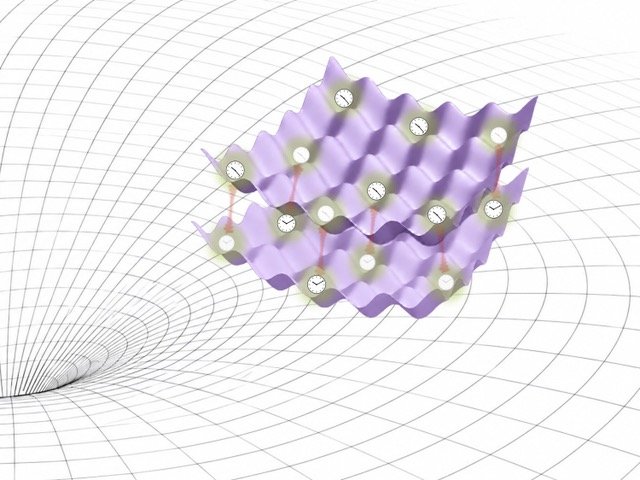
To address these questions, the project will design new experiments using state-of-the-art optical lattice clocks, which combine extreme timekeeping precision with quantum control over atomic motion. We will translate foundational questions into concrete, testable predictions to isolate quantum-relativistic effects in atomic clock systems, and will then work closely with the experimental lab to facilitate laboratory implementation with state-of-the-art multiplexed optical lattice clocks. The project's goal is to develop theory on the quantum aspects of time that stays experimentally grounded while enabling measurements that push tests of fundamental physics into unprecedented quantum regimes.