Davide Tornotti
Affiliation
University of Milano-Bicocca
Supervisors
- Michele Fumagalli (University of Milano-Bicocca)
- Alejandro Benitez Llambay (University of Milano-Bicocca)
Short bio
I earned my bachelor’s and master’s degrees in physics from the University of Milano. Since the end of 2023, I have been a PhD student in the extragalactic research group at the University of Milano-Bicocca, where I study Cosmic Web filaments and the evolution of galaxies embedded within them, mainly from an observational perspective. Through the Enrico Fermi Fellowship, I will connect the latest observations with theoretical models of structure formation and galaxy evolution based on state-of-the-art cosmological simulations.
Unveiling the Universe's backbone: a new view of the gaseous cosmic web and its interplay with galaxies
On the largest scales, matter in the Universe forms a vast network of filaments connecting galaxies. This structure is known as the Cosmic Web, and it acts as the large-scale backbone of the Universe. These filaments contain gas that flows toward galaxies, providing the fresh fuel needed to form stars and grow over cosmic time. For this reason, the Cosmic Web is not just a passive structure - it actively regulates how galaxies evolve.
Despite its importance, this gaseous web has been extremely difficult to observe. Only in recent years astronomers have started to detect it directly in the young Universe, when it was about two billion years old. This became possible thanks to ultra-deep observations with the MUSE instrument on the Very Large Telescope in Chile, which can reveal the faint glow of hydrogen gas stretching across intergalactic space. Contributing to these observations is a central part of my PhD research.
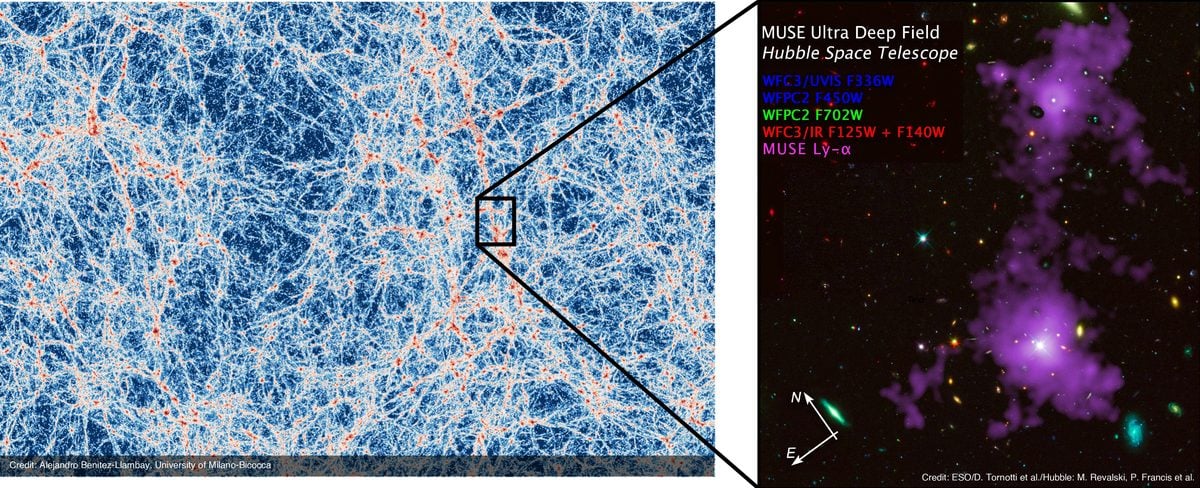
As an Enrico Fermi Fellow, I aim to push this frontier further by connecting these new observations with theoretical models of how structures form in the Universe and how galaxies evolve. I will compare the cosmic filaments we observe with realistic mock observations produced from state-of-the-art cosmological simulations. This comparison will allow me to address two key questions. First, do the observed filaments match the structures predicted by our current cosmological model? Second, how does a galaxy's location within the Cosmic Web influence its properties, such as its mass or how fast it forms stars?
By combining observations and simulations, my work will provide a framework to interpret the first detections of the gaseous Cosmic Web. This will help prepare the ground for the next generation of astronomical surveys, which will discover many more examples of these structures and allow us to study them statistically, offering new insights into how galaxies grow within the large-scale architecture of the Universe.