
Laura Roberts

Affiliation
Max Planck Institute for Gravitational Physics (AEI)
Supervisors
- Aaron D. Spector (Deutsches Elektronen Synchrotron DESY)
- Felix Karbstein (Helmholtz Institute Jena)
Short bio
I am a PhD student at the Max-Planck-Institut für Gravitationsphysik (Albert-Einstein-Institut) in the Department of Precision Interferometry and Fundamental Interactions. I am currently based at the Deutsches Elektronen-Synchrotron (DESY), where I work in the ALPS Optics Group.
Before beginning my PhD, I earned a BSc in Astrophysics from the University of Florida. As an undergraduate, I worked on simulations of starburst galaxies to study chemical tracers of star formation rates and later contributed to telescope testing for the Laser Interferometer Space Antenna (LISA). My work on LISA provided my first experience with optical systems and introduced me to the experimental techniques used in gravitational-wave detection, methods that I now use for studies of fundamental interactions. Since starting my PhD, my research has focused on developing interferometric techniques for measuring vacuum magnetic birefringence (VMB) and searching for particles beyond the Standard Model. Through the Enrico Fermi Fellowship, I aim to bridge theoretical studies of VMB and hypothetical particles with ongoing experimental efforts designed to test quantum electrodynamics and search for new physics.
Testing New Physics with Interferometric Measurements of Vacuum Magnetic Birefringence
Vacuum magnetic birefringence (VMB) is a long-standing prediction of the theory of quantum electrodynamics (QED). VMB describes how a magnetic field excites short-lived “virtual” particle and anti-particle pairs that make the vacuum behave as a polarizable medium. This is a result of quantum vacuum fluctuations, and despite being predicted nearly 100 years ago, VMB remains undetected. If measured at an amplitude that differs from the one predicted by quantum electrodynamics, VMB would provide insights into new physics.
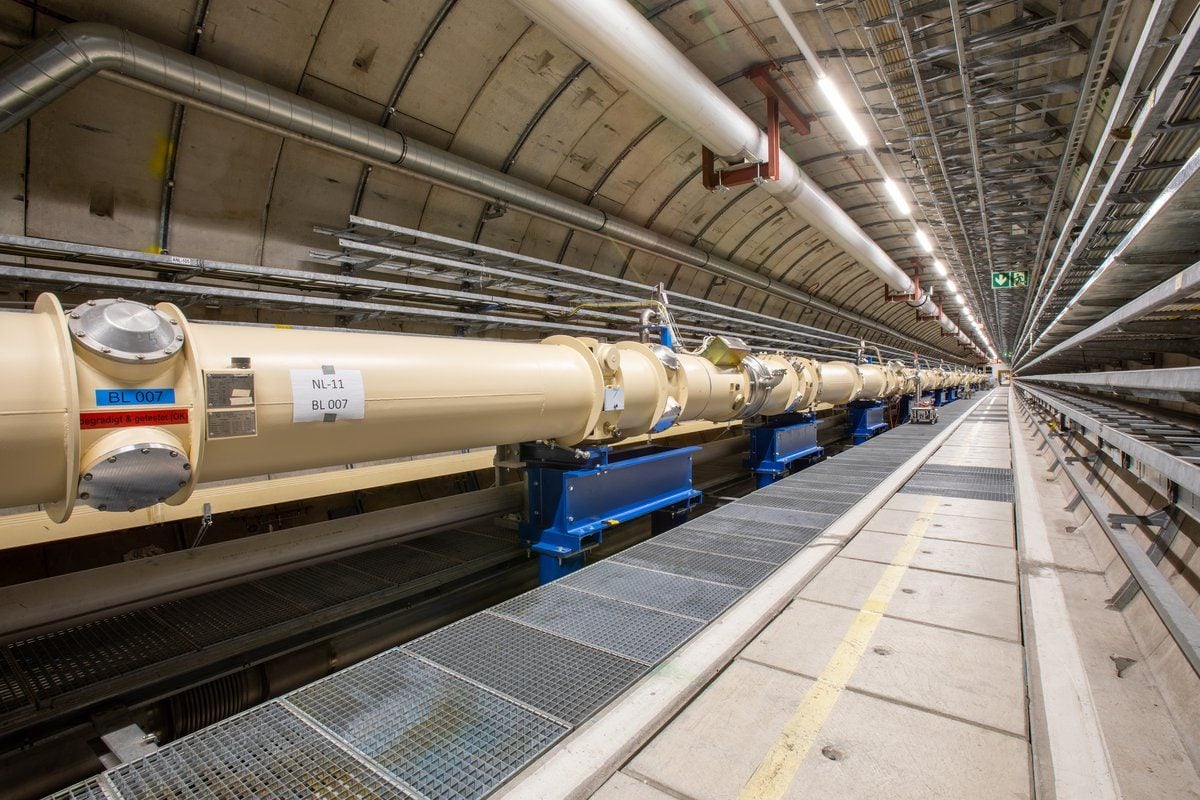
The Any Light Particle Search II (ALPS II) is the largest dark matter experiment in the world and consists of a 212 meter long string of 24 superconducting magnets. We are working towards the first measurement of vacuum magnetic birefringence using the ALPS II magnet string. The experimental goal of this work is to successfully demonstrate a sensing scheme that is capable of measuring extremely small deviations in optical path length due to VMB. We plan to achieve this with an interferometric method utilizing multiple laser fields and precise frequency stabilization to an optical cavity.
Historically, in calculations of the quantum vacuum, theory has relied on the assumption of homogeneous electromagnetic fields interacting with the vacuum. However, since ALPS II is a non-continuous string of superconducting magnets, the light traveling through the string experiences a spatially varying magnetic field, which can modify the interactions with new hypothetical particles. To this end, we plan to develop a unique theoretical description of the experimentally realized environment at ALPS II, providing the opportunity to consistently probe a new parameter space in physics beyond the standard model. Together, these experimental and theoretical efforts create a unified approach to studying the quantum vacuum, leading to key insights into fundamental and new physics.