
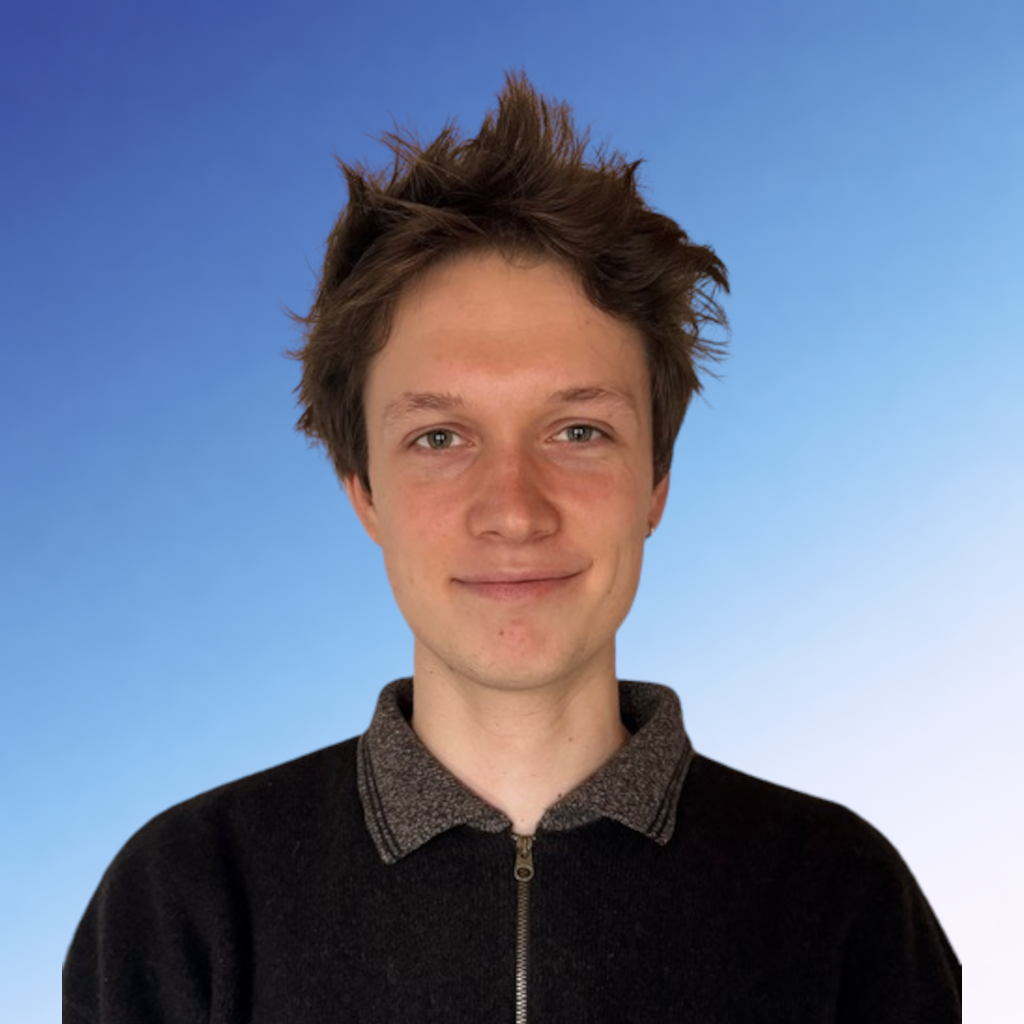
Matisse De Lescluze
Affiliation
Ghent University
Supervisors
- Zoran Hadzibabic (University of Cambridge)
- Michal P. Heller (Ghent University)
Short bio
I am a PhD student in theoretical physics at Ghent University in Belgium. My goal during my PhD is to gain a deep understanding of the dynamics of quantum field theories in out-of-equilibrium
settings. I am particularly interested in the emergence of universal behavior in that context. So far, my research has relied on theoretical and computational methods, but the Enrico Fermi Fellowship offers me the opportunity to approach these questions from the experimental side as well.
A Quasinormal Mode approach to Nonthermal Fixed Points
The universe is full of systems that are pushed far from equilibrium - the violent collision of atomic nuclei at particle accelerators, the cooling of the early universe after the Big Bang, or a super cold gas of atoms suddenly disturbed in a laboratory. Left alone, all of these systems will eventually settle into a calm, featureless equilibrium state. But the journey there is rarely straightforward, and a priori we would expect that this journey looks completely different from system to system.
It turns out that this is not the case. Across vastly different physical settings and energy scales, systems far from equilibrium can get temporarily organized in a surprisingly structured and orderly way - a state that looks almost identical regardless of the details of the system or even how it was initially disturbed. These stages of order in the middle of chaotic evolution are called Nonthermal Fixed Points.
My project asks the following question about these states: how does a system approach and leave them? To answer this, I borrow a concept from black hole physics. When a black hole is disturbed, it rings like a bell, with characteristic frequencies called Quasinormal Modes. These frequencies tell you exactly how the ringing fades away. In my recent work, I showed that Nonthermal Fixed Points have their own version of these modes. Just as a black hole's ringing tells you how it returns to a calm, equilibrium state, these modes tell you how a physical system approaches one of these universal states.
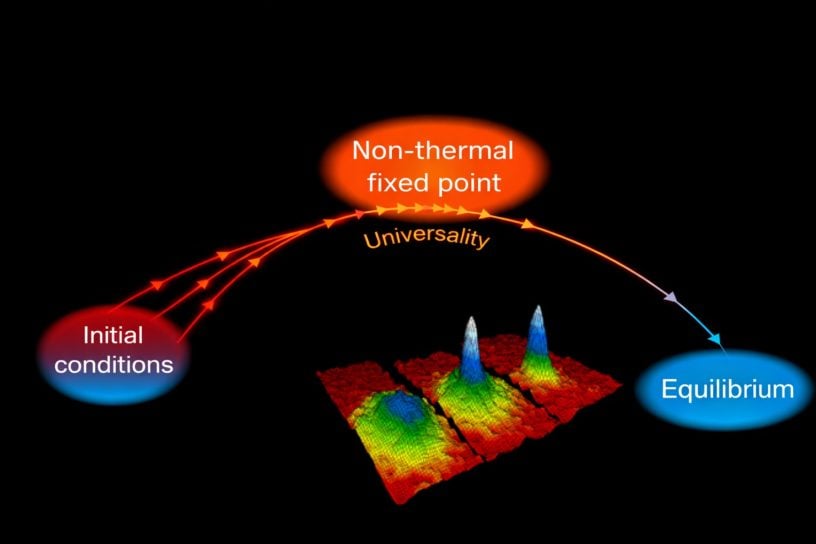
At the Cavendish Laboratory in Cambridge, the experimental group of Prof. Zoran Hadzibabic specializes in pushing ultra-cold gases of atoms out of equilibrium to realize exactly these Nonthermal Fixed Points in a controlled setting. The goal of this project is to measure their Quasinormal Modes experimentally through a close collaboration with this group. From their expertise, I aim to learn how to construct experimental setups that give rise to these far-from-equilibrium phenomena, and which observables are suited to detect the signatures I am theoretically predicting. These insights can then be fed back into calculations in the corresponding microscopic theory. In this way, there will be a back-and-forth between experiment and theory, making the cross-training between both highly valuable to this project. Ultimately, this work aims to get us closer to understanding why quantum systems evolve toward equilibrium and how this happens.