Mingyao Guo
Affiliation
California Institute of Technology
Supervisors
- David Hsieh (California Institute of Technology)
- Yao Wang (Emory University)
Short bio
I am a PhD candidate in the Physics Department at the California Institute of Technology. Prior to this, I obtained my bachelor’s degree in Applied Physics from the University of Science and Technology of China. My research focuses on strong-field light-matter interaction in quantum materials, where the driving laser intensity approaches or even exceeds the inter-atomic bonding strength that is typically on the order of volt per angstrom. As an Enrico Fermi Fellow, I aim to combine ultrafast optical spectroscopy experiments with nonequilibrium quantum many-body theory to study canonical strong-field dynamics in interacting electron systems, e.g., high harmonic generation and Floquet engineering.
Resolving coherent cooperative dynamics in lightwave-driven quantum materials
As quantum science enters its second century, the research frontier is shifting from verification of fundamental quantum mechanical effects towards the understanding and control of many-particle entanglement. Unlike tools developed in the past century, the study of entangled many-body systems places an urgent demand on both experimental and theoretical techniques that can decipher intrinsic quantum properties and intricate microscopic interactions from macroscopic observables.
In recent years, strong light-matter interaction has emerged as a powerful approach for probing and manipulating quantum materials, broadly defined as solids in which strong correlations or electronic topology gives rise to emergent functionalities that could enable entirely new forms of electronics and quantum devices. When driven by light fields on femtosecond timescales, these material systems can be pushed far beyond equilibrium thermodynamics, where intertwined many-body excitations can separate in time and new quantum phases without equilibrium analogues can emerge. For instance, an intense lightwave can transport quasiparticles within a fraction of an optical cycle and lead to high harmonic generation, providing a direct spectroscopic window into the details of electronic bands, quantum geometry, and inter-particle interactions. On the other hand, when the lightwave is sustained over multiple optical cycles, Floquet engineering - the coherent control of quantum systems by periodic driving - promises to renormalize the microscopic interaction parameters and manipulate and even create materials' properties on demand.
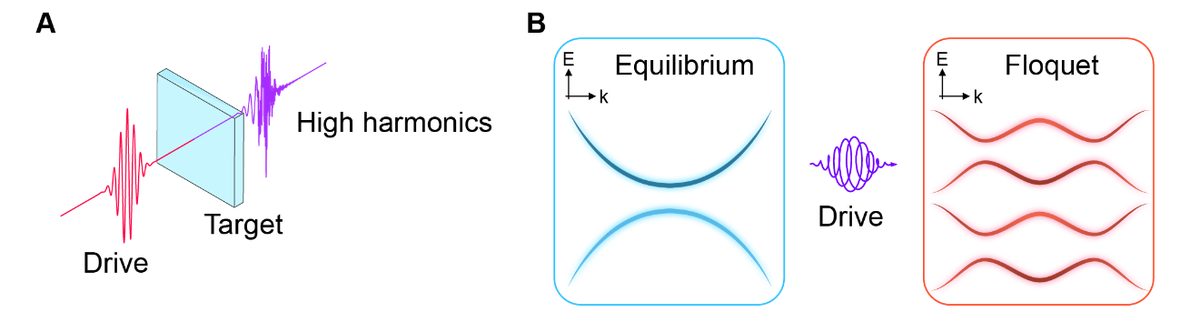
The past decade has witnessed the birth of a series of strong-field (characteristic intensity ~1 TW/cm2) phenomena in weakly correlated solids, ranging from attosecond control of optoelectronic processes to Floquet band structure engineering. Building upon these advances, my project aims to resolve the coherent dynamics of strongly driven interacting many-body systems. A central challenge is that entanglement causes experimental observables often comprising intertwined responses from multiple degrees of freedom, making quantitative comparison with accurate numerical simulations necessary to disentangle their respective contributions. At the same time, theoretical models frequently employ idealized parameters that are difficult to realize in real materials and predict quantities not directly measurable in experiments. Bridging the gap between these fronts is essential for turning strong-field spectroscopy into a quantitative probe of correlated quantum materials. Synergizing the Hsieh and Wang groups' expertise in ultrafast optics and quantum many-body theory, I will design experiments to uncover new lightwave-driven cooperative phenomena and reveal the underlying microscopic processes through numerically unbiased, wavefunction-based simulations.